
Overview
Build confidence before the calendar changes.
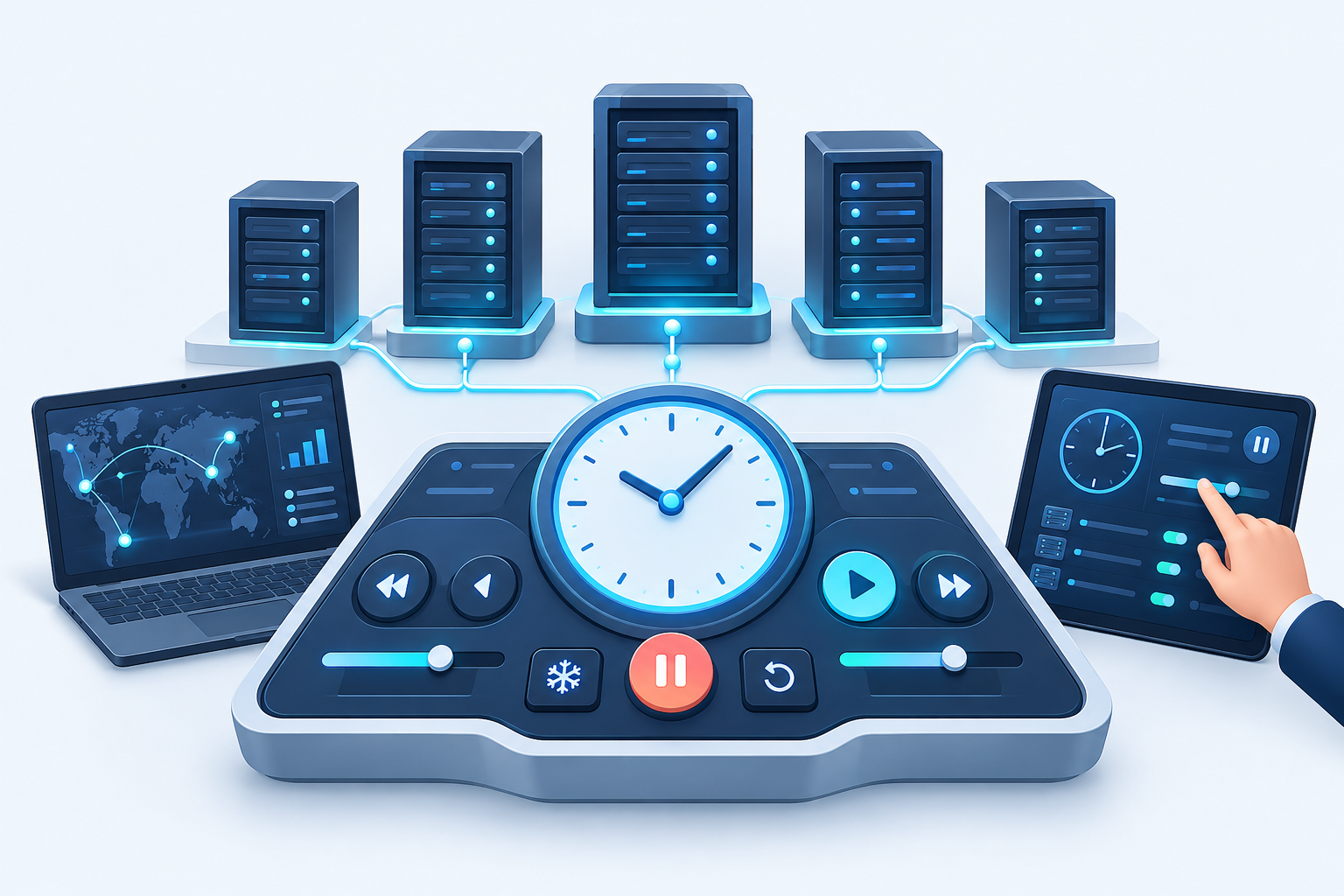
Time travel testing validates date- and time-sensitive business logic before important dates arrive. It is also known as temporal testing, forward-date testing, time-shift testing, or date-simulation testing.
Representative Scenarios
What teams can bring into the test cycle
- Leap years and daylight-saving time
- End-of-month, quarter, and year processing
- Insurance rates and policy expiration
- Billing cycles and loan repayment
- Tax and financial validation
- Enrollment and eligibility windows
Manual server-clock changes
Direct clock changes may appear simple but can require downtime, administrator coordination, restoration work, and can disrupt domain authentication, backups, timestamps, and batch processing.
Isolated environments
Separating servers from the authenticated domain adds infrastructure cost and can make the test environment less representative of production.
Hardcoded test harnesses
Custom date logic adds development and maintenance work, cannot wrap proprietary third-party software, and is difficult to synchronize across distributed stacks.
Skipping temporal testing
Not testing leaves production exposed to date bugs in financial, insurance, government, healthcare, energy, and other calendar-dependent systems.
Virtual-time automation
TimeShiftX applies virtual dates to selected applications and databases while host clocks, security protocols, and core system files remain current.